
Low-Ozone Engineering: Why Responsible Ion Air Care Matters
Effective Ion Air Care Should Control Ozone—Not Depend on It
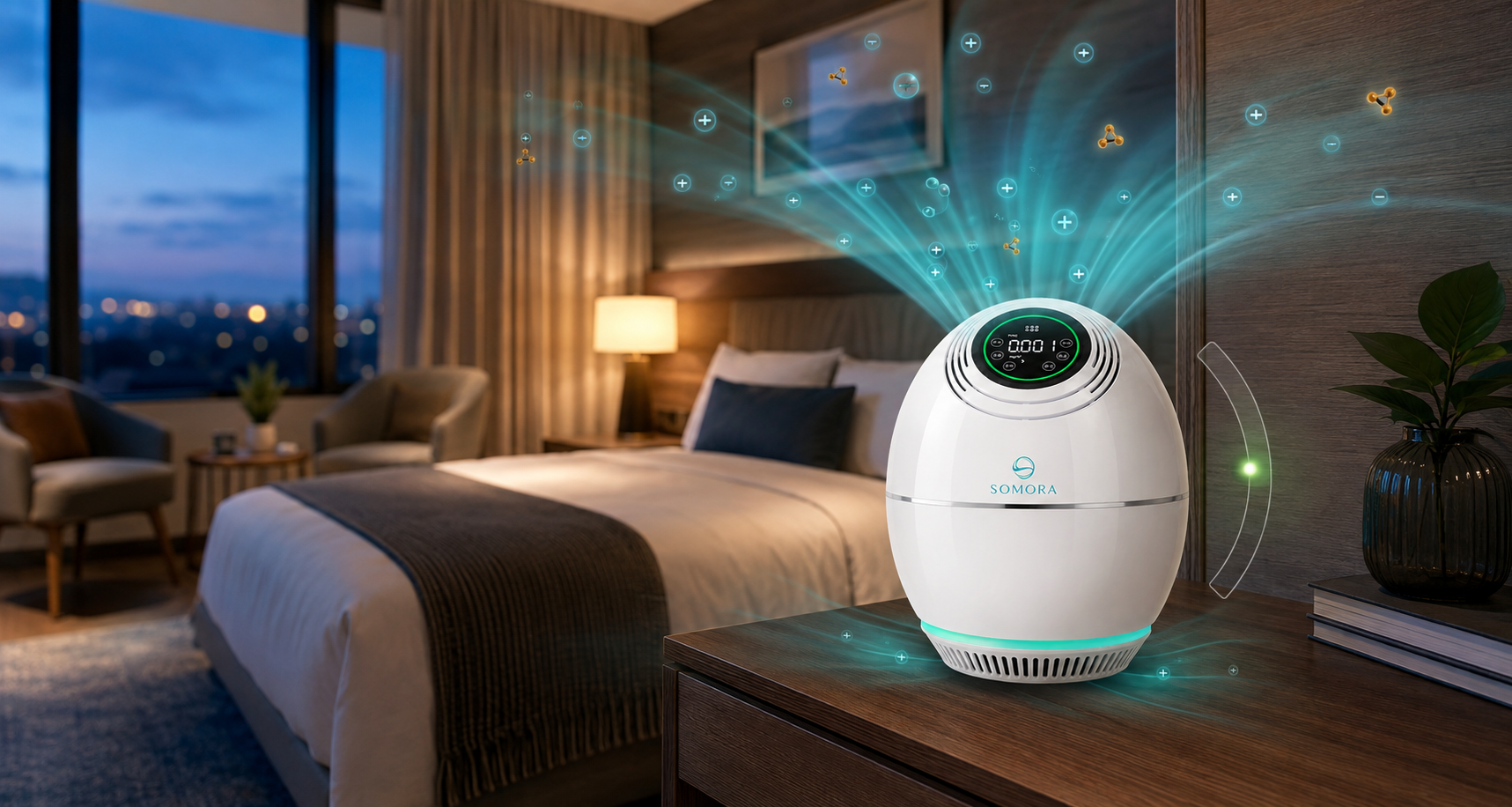
Ion-based air care and ozone generation are sometimes discussed as though they were the same technology. They are not.
An ion air-care device uses an electrical field to create charged species that interact with components of the surrounding air. Ozone may be produced unintentionally by some electrical-discharge systems, but it should not be treated as the primary cleaning mechanism in an occupied indoor environment.
Responsible ion air care therefore begins with a clear engineering objective: generate and distribute the intended ion output while controlling unwanted ozone emissions.
Ions and Ozone Are Not the Same
Ions are electrically charged atoms, molecules or molecular clusters. In an ion air-care system, charged species are released into the surrounding air and may interact with airborne particles and other targets, depending on the technology and operating conditions.
Ozone is a molecule composed of three oxygen atoms. It is highly reactive and may be generated directly by an intentional ozone generator or indirectly as a by-product of some ionizers, electrostatic devices, plasma systems and electrical-discharge technologies.
This distinction matters.
A device can use ion technology without being designed as an ozone generator. However, responsible manufacturers must still evaluate whether ozone is produced during operation and how much is released under realistic conditions.
Why Ozone Control Matters in Occupied Spaces
Ozone’s reactive properties are sometimes promoted as a way to remove odors or indoor pollutants. However, the U.S. Environmental Protection Agency states that ozone concentrations within public-health limits have limited ability to remove many indoor contaminants.
The EPA also identifies ozone as a lung irritant and advises against using devices that intentionally generate ozone in occupied spaces.
This does not mean every ion-based device should be treated as an intentional ozone generator. It means that electronic air-care technologies must be designed, tested and described responsibly.
For SOMORA, the objective is not to depend on ozone. The objective is to support everyday ion-based air care while keeping ozone emissions controlled.
What Influences Ozone Emissions?
Low-ozone performance is not created by one marketing label. It depends on multiple engineering and operating factors.
These may include:
Emitter geometry and electrode spacing
Electrical voltage, waveform and current stability
Insulation and surrounding materials
Air-channel and airflow design
Output-control logic and operating modes
Temperature and relative humidity
Dust or contamination on emitter surfaces
Component aging and maintenance condition
A device that performs well when new should also be evaluated for stable long-term operation. Dust accumulation, damaged components or incorrect cleaning may affect both ion output and unwanted by-product emissions.
This is why low-ozone engineering includes not only the ion generator itself, but also the product’s airflow, control system, safety protection and maintenance instructions.
Testing Must Reflect Real Operating Conditions
A meaningful ozone result should always identify the conditions under which the measurement was obtained.
Important information includes:
The exact model or tested sample
Room or test-chamber volume
Operating level and airflow setting
Test duration
Measurement distance
Temperature and humidity
Background ozone level
Test instrument and detection limit
Applicable laboratory method or standard
A number without these conditions provides very little information.
Results obtained from one model, operating mode or test chamber should not automatically be applied to another SOMORA product. Changes to the ion module, fan, housing, air channel, control logic or power system may affect the final result.
A Representative Product Test
For one representative product sample identified as KZYJ-103, third-party testing reported an average ozone concentration of 0.006 mg/m³ after 60 minutes of operation in a 30 m³ test chamber.
The same test documentation recorded airflow of 289 m³/h under the stated energized operating condition.
These figures demonstrate the importance of reporting ozone and airflow together. A product must distribute air effectively while controlling unwanted emissions; a very low output that does not reach the occupied space would not represent meaningful whole-room engineering.
This result applies only to the tested KZYJ-103 sample and the conditions stated in its report. It should not be automatically presented as a result for every SOMORA model.
It also does not, by itself, constitute CARB, UL or market-specific certification. Those claims require testing and certification under the applicable procedures for the exact product being sold.
“Low Ozone” Is More Accurate Than “Ozone-Free”
SOMORA’s preferred wording is:
“Low ozone emission tested under stated conditions.”
This wording is accurate, transparent and connected to test evidence.
An “ozone-free” statement is an absolute claim. It should not be used unless the exact model has completed an appropriate third-party zero-ozone certification or validation.
Even when a test result is reported as “not detected,” the result may mean that the concentration was below the instrument’s detection limit—not necessarily that absolute zero ozone existed.
Responsible communication should therefore distinguish among:
Measured low ozone concentration
Ozone below a stated detection limit
Compliance with a specified emission limit
Formal zero-ozone certification
These statements are not interchangeable.
Low Ozone Must Be Balanced with Effective Air Distribution
Ozone control is essential, but it is not the only engineering objective.
Ion output must also be distributed through the occupied space. SOMORA combines ion generation with active airflow and designed air channels to support more even whole-room circulation.
Responsible product evaluation should therefore consider:
Ion-generation stability
Positive and negative output strategy
Airflow and circulation
Room-size suitability
Ozone and other by-product emissions
Noise, energy use and maintenance
Product-specific performance evidence
A dramatic ion count measured near the emitter does not establish whole-room effectiveness. In the same way, a low ozone figure alone does not prove that the device provides useful air-care performance.
The design must balance controlled emissions with stable output and appropriate circulation.
Responsible Use Is Part of Responsible Engineering
Low-ozone design does not remove the need for correct product use.
Users should follow model-specific instructions, keep air inlets and outlets unobstructed and clean the product according to the maintenance guide. Ventilation, source control and normal room cleaning should continue to form the foundation of indoor air-quality management.
Ion air care should not be presented as a medical treatment, a replacement for ventilation or a guarantee against infection.
Product claims should remain limited to the tested model, target, operating conditions and available evidence.
The SOMORA Approach
SOMORA treats ozone control as a core element of responsible ion air care.
The goal is not to create the strongest possible electrical discharge. It is to engineer a stable system that combines:
Controlled non-equilibrium positive and negative ion output
Active whole-room air circulation
Low-ozone design and testing
Quiet and energy-conscious operation
Model-specific performance verification
Clear operating and maintenance guidance
Responsible air-wellness technology should be designed for the way people actually use indoor spaces: continuously, comfortably and with people present.
That is why low-ozone engineering is not a minor specification. It is part of the product’s safety philosophy, technical credibility and long-term value.
Explore SOMORA Products, Technology and Solutions to learn how low-ozone ion air care can be configured for bedrooms, hotel rooms, studies, vehicles and other occupied spaces.


